Mercedes cle: a clash of champions – is the new amg traveler the true winner?
Mercedes has thrown down the gauntlet, combining two once-separate models – the C and E-Class Cabriolets – into the new CLE. It’s a bold move, and one that immediately raises questions about the brand’s direction. Forget the predictable evolution; this is a statement, a challenge to BMW and a subtle shift towards a more refined, less overtly performance-focused AMG.
Decoding the cle: more c than e?
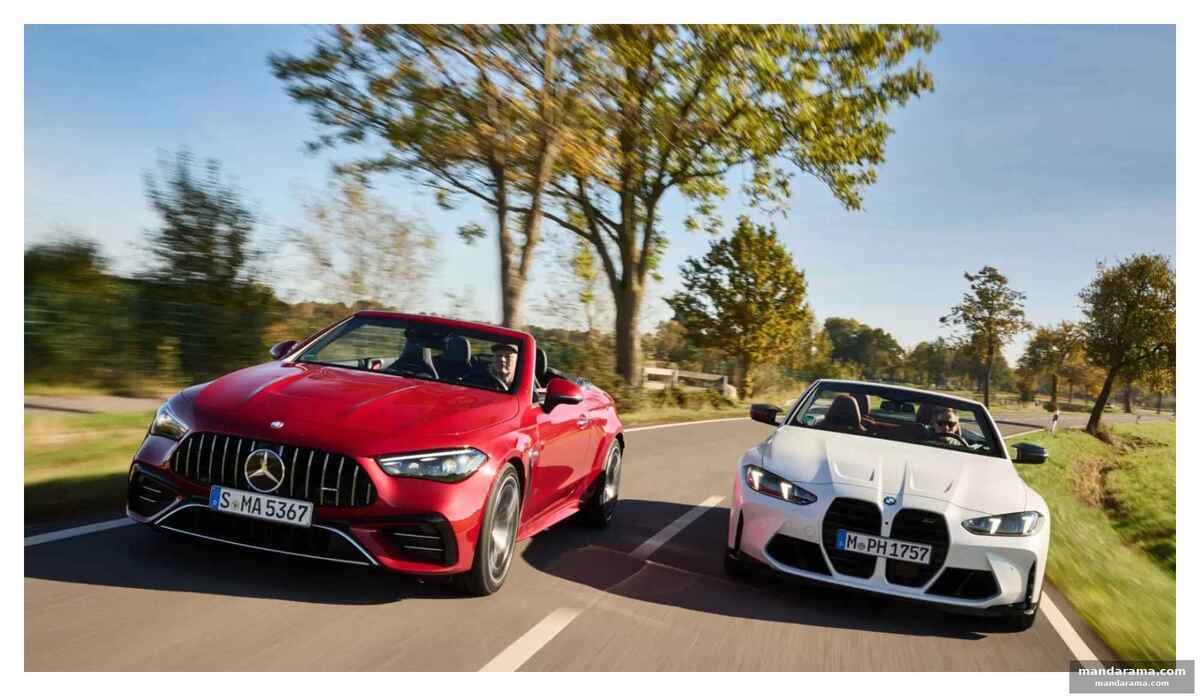
Technically, the CLE leans closer to the C-Class than the E-Class, despite its 4.85-meter length – a mere five centimeters longer than the BMW M4 Cabrio. But don’t mistake practicality for compromise. Underneath the stylish exterior lies a potent engine and a distinctly AMG character.
The aggressive front grille, a signature BMW trait, is present on the M4, mirroring its coupe sibling. While the BMW boasts a speedy 20-second roof deployment – even at higher speeds – the CLE takes a more leisurely 22 seconds, utilizing a remote control option. Subtle differences, perhaps, but they contribute to a different driving experience.
A cabin of contrasts
The interior of the CLE is a study in contrasts. Dominated by swathes of black and accented with chrome, it exudes a certain glamour – almost aggressively so. Think Mariah Carey at Christmas, and you’ll get the idea. It’s undeniably opulent, but is it overly styled? Personally, I find it intoxicating.
The BMW M4 Competition Cabrio, in stark contrast, maintains a more restrained aesthetic. Its design is undeniably purposeful, though the optional carbon fiber bucket seats, while visually striking, aren’t essential. The standard seats are remarkably comfortable, providing ample support. The rear passenger space is comparable between the two, though the M4 offers marginally better legroom.

Power and performance: a battle of titans
Both vehicles are powered by a 3.0-liter inline-six engine, but with significantly different outputs. The AMG CLE 53 delivers a formidable 449 horsepower, combining a turbocharger with an electric compressor for a remarkably smooth and responsive power delivery. It accelerates from 0 to 100 km/h in just 4.2 seconds, topping out at 270 km/h. The BMW M4 Competition Cabrio, however, unleashes a more aggressive 530 horsepower and 650 Nm of torque, blasting to 100 km/h in a blistering 3.5 seconds – nearly a full second faster than the Mercedes.
The BMW’s structural reinforcements, designed to mitigate the stresses of its twin-turbo setup, are a testament to its engineering prowess. This translates to a lighter weight – 2,108 kilograms compared to the CLE’s 2,285 kilograms – and a more agile feel on the road.

Efficiency and economy
Despite the increased power, the CLE demonstrates a surprising degree of efficiency. With an estimated 11.3 liters per 100 kilometers, it edges out the M4’s 12.5 liters. The CLE’s mild hybrid system contributes to this advantage. However, the added complexity of the system is noticeable, requiring occasional manual interventions via the steering wheel-mounted paddles.

The verdict: a traveler with bite
Ultimately, the BMW M4 Competition Cabrio emerges as the clear victor. Its raw power, sharper handling, and lighter weight combine to create a more engaging and genuinely sporty experience. While the Mercedes-AMG CLE 53 offers a more refined, luxurious – and arguably more practical – alternative, it doesn’t quite match the M4’s dynamism. Mercedes has created a compelling machine, but it’s the Bavarian that truly steals the show.